
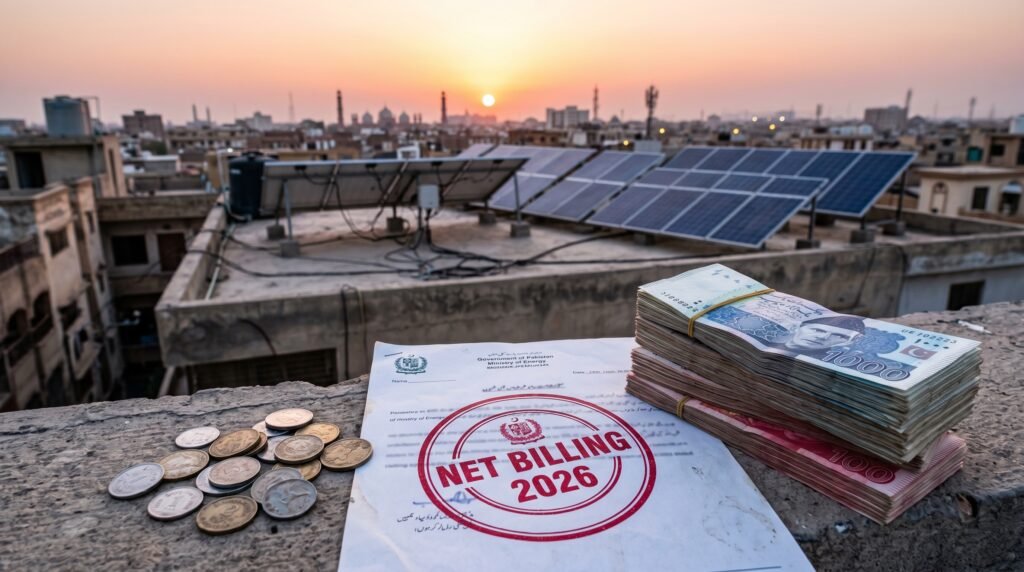
The government of Pakistan changed the solar net metering rules in February 2026. If you have solar panels or plan to install them, you need to understand the new policy. This guide explains everything in simple words.
What Was Net Metering Before 2026?
Before 2026, net metering was very simple.
- You installed solar panels on your roof.
- Extra electricity went to the grid.
- The government paid you the same price for every unit you sent.
- You also paid the same price when you used electricity from the grid.
This system was very good for solar users. But the government changed it.
What Are the New Rules in 2026?
The new system is called “Net Billing”. It is not the same as net metering.
| Old Rule (Net Metering) | New Rule (Net Billing) |
|---|---|
| Same price for sending and using electricity | Different prices |
| You get paid up to Rs. 25–30 per unit | You get paid only Rs. 8.13 to Rs. 11 per unit |
| You pay Rs. 37–60 per unit when you use grid electricity | Same as before (Rs. 37–60 per unit) |
So now, you sell electricity cheap (Rs. 8–11) and buy electricity expensive (Rs. 37–60). This makes solar less profitable than before.
Do You Still Need a License?
Yes. Even for small systems (1 kW to 25 kW), you must get a license from NEPRA.
But the good news: the license fee is now zero (free).
You still have to apply online through the NEPRA portal.
What About Existing Solar Users?
If you already have a net metering connection before February 2026, your old rules will continue until your agreement expires. After that, you will also move to the new net billing system.
So existing users are safe for some time, but not forever.
Why Did the Government Change the Rules?
The government says:
- Too many people installed solar and stopped paying grid bills.
- The grid still has fixed costs (wires, transformers, employees).
- They want everyone to share these costs fairly.
But many people are angry. They say the government is killing solar growth in Pakistan.
Is Solar Still Worth It in 2026?
It depends.
| Situation | Still Worth It? |
|---|---|
| You live in an area with load shedding | Yes, because you need backup power |
| You have high electricity bills (above Rs. 30,000/month) | Maybe, but payback period is longer now |
| You want to sell extra power to make money | No, because selling price is too low |
| You can go completely off-grid | Yes, but battery costs are high |
Many people are now choosing off-grid systems with batteries. They disconnect from the grid completely. This way, they don’t have to follow NEPRA’s rules.
What Should You Do Now?
- If you haven’t installed solar yet – Calculate carefully. With new rules, your payback period may increase from 3–4 years to 7–10 years.
- If you want to stay on-grid – Apply for a net billing license (free but mandatory).
- If you want to go off-grid – Buy good batteries and a hybrid inverter. You will not need any license.
- Check for subsidies – Khyber Pakhtunkhwa government is giving free or 50% subsidized solar to low-income families. Punjab and federal schemes are limited.
Final Verdict
The 2026 net metering policy is bad news for people who wanted to save money by selling extra power. But solar still makes sense for backup power and for areas with frequent load shedding.
Think carefully before you invest. And always talk to a local solar installer before making a decision.
Have questions?